Charles Darwin
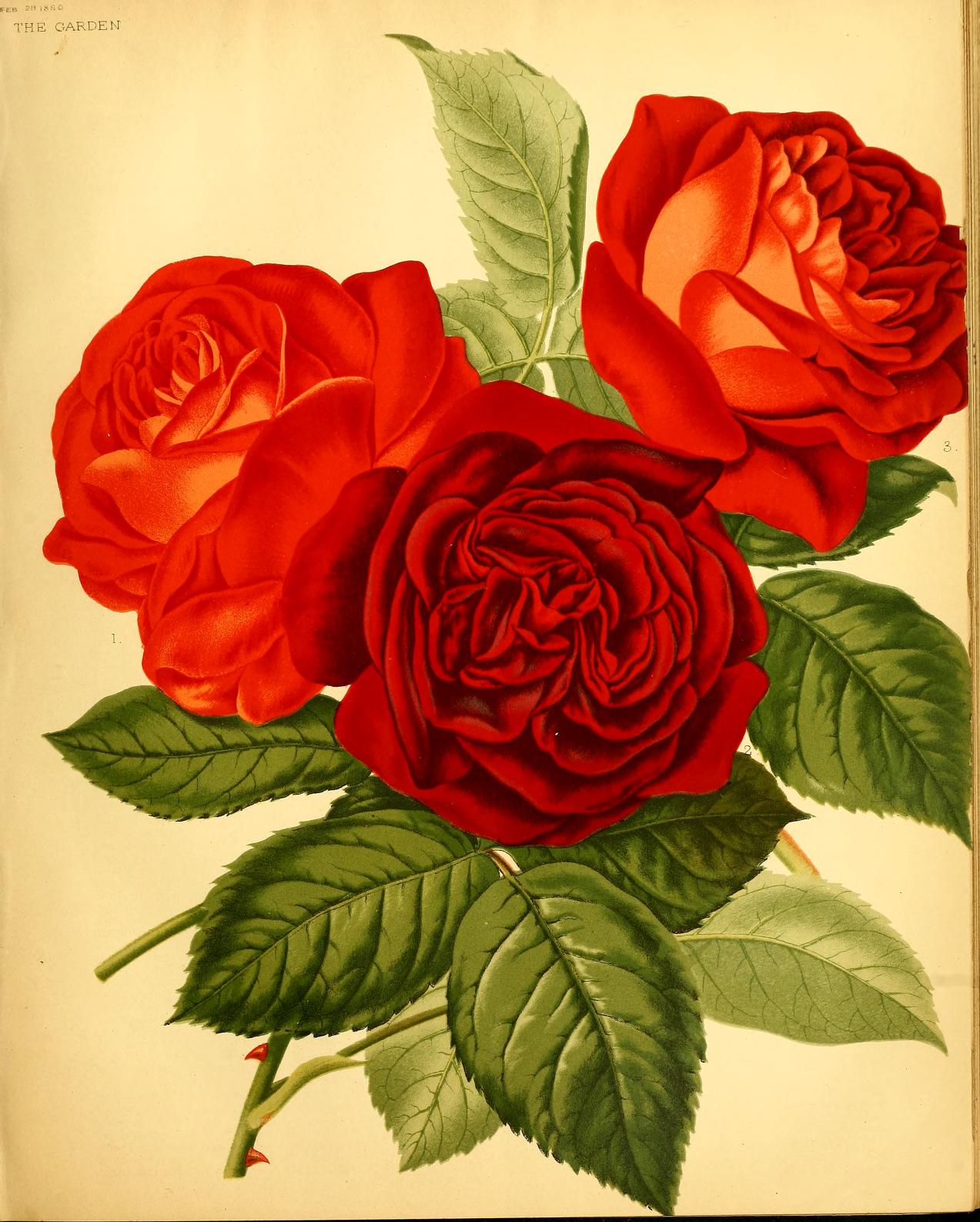
Remontantka.
Hodowca – Firma Paul & Sons/wg. Tygodnika The Garden z roku 1880/, albo Laxton Bros – to wg. HMF.
Odmiana najprawdopodobniej utracona.
Tyle suchych danych. Przeczytajmy jeszcze jak opisał je niepodpisany autor w tygodniku The Garden z roku 1880.
Róże, reprezentowane na naszej rycinie w tym tygodniu, to nowe trzy odmiany wyhodowane przez spółkę Paul & Sons, z Cheshunt i musimy przyznać , że są to jedne najpiękniejszych róż jakie powstały w naszym kraju. Zwłaszcza odmiana Duke of Teck , zasługuje na wszelkie pochwały jakimi została obdarzona, jak i też na te wszystkie certyfikaty jakimi została nagrodzona na różnego rodzaju wystawach. Blask jej koloru, któremu najbliżej jest do szkarłatu jest bezkonkurencyjny dla innych róż w swojej klasie.
Odmiana Charles Darwin, podobnie jak i poprzednik jest jedną z zeszłorocznych nowości i charakteryzuje się bardzo swoistym bogactwem odcieni kolorystycznych i całkiem słusznie uznawana jest za odmianę, która proponuje nam całkiem nowy odcień koloru. Doskonałe odczucie jakie towarzyszy oglądaniu tej róży wzmacnia jeszcze bezbłędnie uformowany w kulę kwiat, co podkreślane jest przez nieco odgięte płatki. Odmiana ta, kwitnie bardzo swobodnie i świetnie sprawdza się na podkładkach z róży Manetti, a kwitnienie jesienne jest wybornej jakości.
Jeszcze wcześniej bo w roku 1878 wyhodowana została Mrs. Laxton. Również ona podkreśla wysoką jakość róż z firmy z Chesnut.. Na naszej ilustracji przedstawiona jest w nieco żywszych barwach niż Duke of Teck, choć w rzeczywistości nie jest to prawdą. Kwiat jej uosabia ideał doskonałej róży. Płatki rozmieszczone są symetrycznie i lekko podwinięte a zewnętrzne rzędy odgięte, tworząc jak gdyby frędzle.
878 .]
ROSE CHARLES DARWIN.-VINES AND VINE-CULTURE—CHAP. XIV.
1G1
HOSE CHARLES DARWIN.
[Plate
OR the specimen of the fine new H.P.
Rose named Charles Darwin, we are
indebted to Messrs. Paul and Son, of
the Old Nurseries, Cheshunt. It is remarkable
at once for its rich deep maroon-shaded
colour, and also for its free autumn-blooming
properties, rendering it “ perpetual ” in some¬
thing more than the name. Mr. G-. Paul has
very kindly sent us the following notes, to ac¬
company the figure :—
“ This is a seedling of Mr. Laxton’s, which
some three years ago he placed in our hands
for trial. It has proved to be a very fine rose,
with the merit of novelty of colour, having a
brownish tint suffused over the crimson, and
having a wonderfully decided habit of autumn
flowering ; indeed, throughout all the quarters,
no single variety at this date (September 17) is
covered to an equal extent with well-developed
flowers. This is evidently due to some Bourbon
blood in its parentage, and is a most desirable
quality. On its merits, we have decided to dis¬
tribute it next spring.
“ Curiously enough, the English-raised Boses
of the last two years seem to be the best of the
new kinds. Taking those of 187G-7, Mr.
Turner’s Oxonian and Mrs. Baker (187G), with
our Duke of Connaught and Sultan of Zanzi¬
bar, and Mr. W. Paul’s Magna Charta, are the
new kinds of the year worth growing.
“Of 1877, nearly the same holds good.
Emily Laxton and Marchioness of Exeter, and
Mrs. Laxton (1878), raised by Mr. Laxton, sent
478.]
out by us ; Mr. Postans’ May Quennell, sent out
by Messrs. William Paul and Son ; and Mr.
Davis’s Penelope Mayo, sent out by Mr. Turner,
are, with our own John Bright and Robert
Marnock, the best of the year.
“ Of the French kinds of 1877-8, taking first
the hybrid perpetuals, we hold Alfred K.
Williams, a new Horace Vernet-like flower,
Garcon’s Boildieu, sent out by Margottin, a
large, bold flower, and Eduard Dufour, of
Leveque, are the best amongst the crimsons.
Madame Jean Bowyer is in the way of Marie
Finger, and is promising; Liabaud’s two,
Madame Gabriel Luizet and Madame Laboulaye,
an improved Duchess of Edinburgh, are pro¬
mising lights. Mr. Guillot’s Hybrid Tea
Mdlle. Alexandre Bernaix, and Leveque’s Prin-
cesse de Tremouille, are both free-blooming
and La France-like roses.
“ Of the Teas, we think highly, from flowers
seen here, of Mr. Bennett’s Madame Welch, a
seedling of Madame Duclier, at Lyons; and
Lacharme’s Madame Lambard is a good vigorous
free-flowering Tea, of soft rosy-peach colour,
likely to be particularly useful. A new raiser,
Nabonnand, sent out some ten or twelve new
Teas, some of which, as Princess Vera, look
pretty ; but to be useful now, a Tea Rose must
have a bold vigorous habit and large perfect
flowers, or we might as well revive some of the
old varieties, like Caroline and Tea Jaune,
which have been thrown out of the Catalogues.
“ It is pleasant to find that Roses continue
to progress, and pleasanter to find English-
raised kinds heading the lists.— George Paul.”
VINES AND VINE-CULTURE.